Description
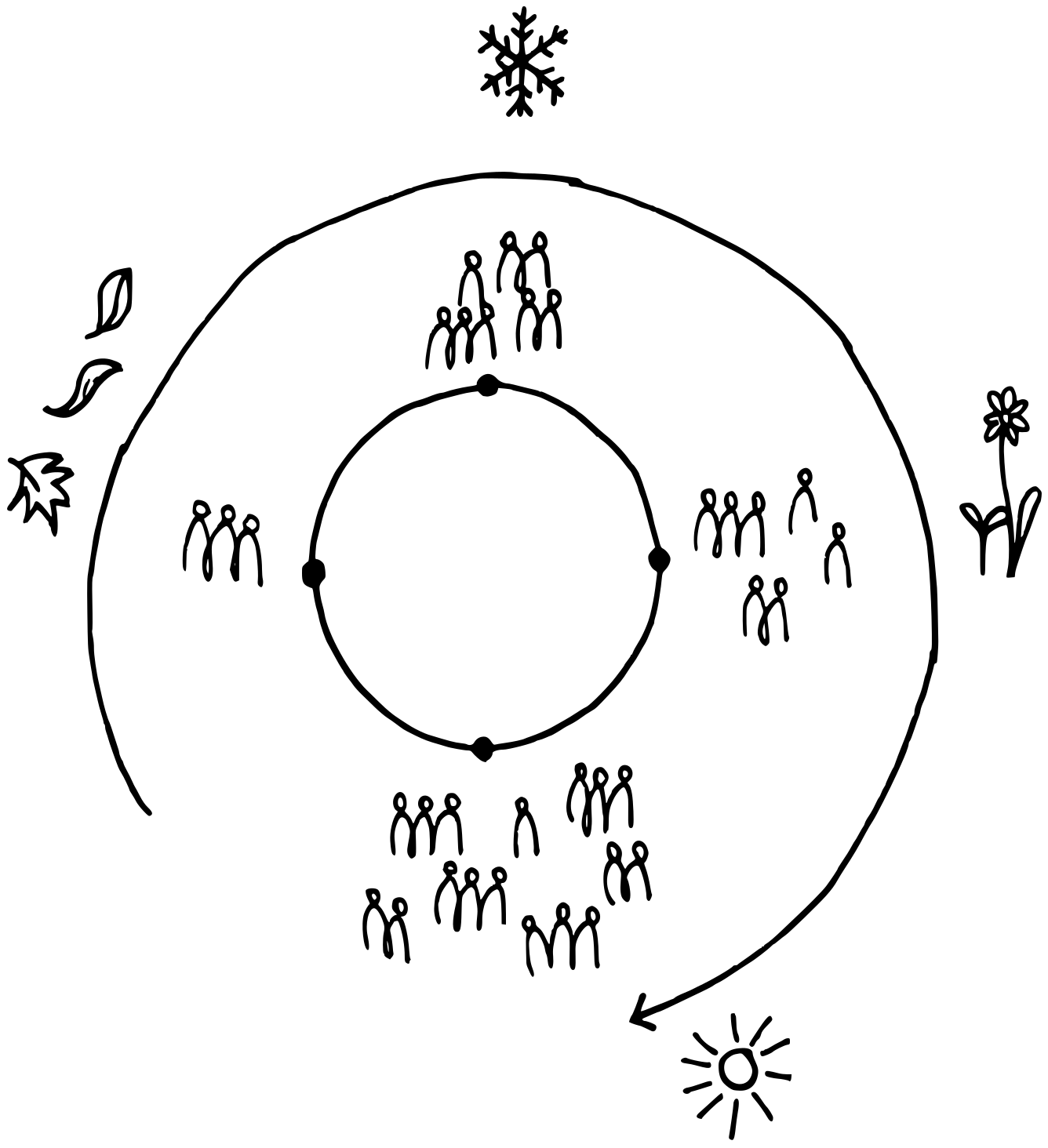
A growing number of practitioners, activists, and researchers are advocating for permanent, or institutionalised CCAs that can support long-term transformations, independent of short-term political cycles. Enabling this would require profound transformations in central aspects of societies such as work, production, and care. Such a shift would lead to fundamentally different forms of governance and societies. Historical and contemporary experiments include council democracy and anarcho-syndicalism, or methods like sociocracy, liquid democracy, and platform cooperativism, and myriad commoning practices and visions of common-ism. Pioneering communities, such as the Zapatistas or the Democratic Autonomous Administration of North and East Syria (also known as Rojava), are experimenting with grassroots self-governance and democratic confederalism, demonstrating different pathways to enduring, systemic participatory governance.
However, CCAs remain far from achieving this level of self-organised power. Yet the practices emerging within them, and the experiences with the first permanent assemblies, such as Belgium and Milan, may point towards more enduring forms of democratic participation. The examples above can serve as inspiration and as a utopian horizon towards which to move while → Reflecting Deliberation Along the Way.
How-To & Examples
The FIDE/KNOCA note Towards Permanent CCAs outlines promises and limitations. while How to use Citizens Assemblies Permanently highlights implementation considerations for permanent CCAs
Belgian Sortition Models are pioneering permanent CCAs: In “Ostbelgien”, a CCA has been active since 2019, consisting of a Citizens’ Council (CC), citizens’ assemblies (CA), and a permanent secretariat. Each CA includes 25–50 randomly selected citizens. The CC, composed of 24 former participants, organises assemblies, selects topics, and supports monitoring of policy implementation. Members serve up to 18 months to ensure continuity while bringing in new voices. The Ostbelgien Model.
In Brussels a mixed mode links citizens’ deliberation (in person and online) more directly to representative institutions by integrating 45 randomly selected citizens and 17 legislators in a joint committee. The parliament retains agenda-setting power and the assembly is only partially institutionalised. Assemblee Climat
The permanent CCA Milano Cambia Aria focuses on climate and air quality, with 90 citizens selected yearly who meet monthly and provide recommendations to the city administration.
The Climate Plan of South Tyrol (p. 76) foresees continuing with CCAs “in a certain rhythm”, while the local initiative ‘Zukunftspakt - Patto per il Futuro’ proposed a model with a permanent citizen council and recurring CCAs to ensure continuity. The Zukunftspakt Model participatory Transformation
Literature & Sources
FIDE/KNOCA 2023 https://uploads-ssl.webflow.com/65b77644e6021e9021de8916/65ddc119b11f3cb81207d076_Towards-permanent-climate-assemblies_Draft-for-comment.pdf
https://www.publicdeliberation.net/the-ostbelgien-model-five-years-on/
https://www.interregeurope.eu/good-practices/permanent-citizens-dialogue-in-ostbelgien
https://democracyrd.org/wp-content/uploads/2024/08/PDF-Guia3-Case-Studies-1-Ostbelgien.pdf https://www.demnext.org/projects/scaling-democratic-innovations?referrer=luma
https://www.buergerrat.de/en/news/thanks-for-giving-me-hope/
https://home.crin.org/childrens-rights-and-deliberative-democracy
https://delibdemjournal.org/article/id/326/
https://publicagenda.org/wp-content/uploads/Imagining-the-Robust-Deliberative-City.pdf
https://www.cambridge.org/core/journals/canadian-journal-of-political-science-revue-canadienne-de-science-politique/article/decolonizing-deliberation-experiments-from-aotearoa-new-zealand/931E12CF5500CB8EE0108213AB131061